INTRODUCTION
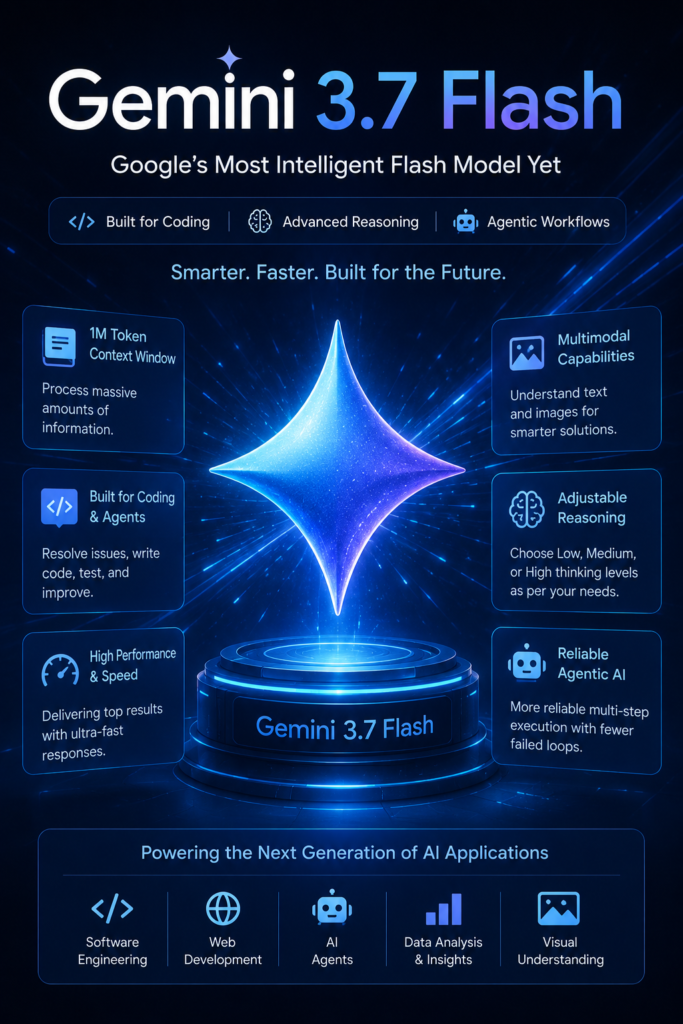
Artificial intelligence models are becoming faster, smarter, and more capable with every major release. Google has now introduced another significant addition to its Gemini family: Gemini 3.7 Flash. The gemini new model is designed as a high-performance workhorse for coding, reasoning, agentic workflows, web development, and large-scale AI applications.
Google announced Gemini 3.7 Flash on August 13, 2026, describing it as its most intelligent Flash model yet for coding and agents. The release arrived only three weeks after Gemini 3.6 Flash, showing how rapidly Google is improving its model lineup.
What makes this release especially interesting is its positioning. Gemini 3.7 Flash is not simply designed to answer questions quickly. It aims to combine strong reasoning with high output speed, multimodal capabilities, long-context processing, and lower operating costs.
This article takes a detailed look at the gemini new model, including its major features, gemini 3.7 flash benchmark results, gemini 3.7 flash pricing, and detailed comparisons involving Gemini 3.1 Pro and GLM-5.2.
What Is the Gemini New Model?
The latest Gemini release is Gemini 3.7 Flash, identified through the API model name gemini-3.7-flash. Google currently lists it as generally available and ready for production use.
The model is specifically positioned for complex coding tasks, agentic workflows, and reliable multi-step execution. Its default thinking level is medium, although developers can choose between low, medium, and high reasoning levels depending on their workload.
This approach makes Gemini 3.7 Flash different from a model designed only for simple conversations. A coding agent, for example, may need to understand a problem, inspect files, create a solution, test it, identify mistakes, and make corrections.
Gemini 3.7 Flash is designed to handle this kind of workflow more effectively. Google says the model delivers substantial improvements in software engineering, knowledge work, web development, and agentic tasks.
Gemini 3.7 Flash Key Features
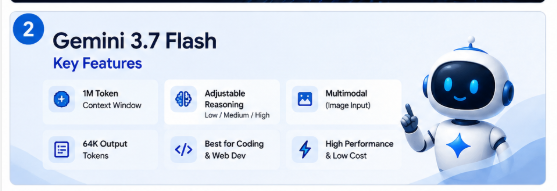
One of the most important features of the gemini new model is its enormous context capacity. Gemini 3.7 Flash supports a 1-million-token context window, allowing applications to provide very large amounts of information in a single interaction.
The model supports up to 64,000 output tokens. This provides enough room for lengthy responses, substantial code generation, detailed analysis, and complex multi-step outputs without requiring applications to constantly divide tasks into smaller requests.
Another major feature is adjustable reasoning. Developers can select low, medium, or high thinking levels. Lower reasoning can be useful when speed is the priority, while higher reasoning can be selected for complicated coding, planning, or analytical workloads.
This flexibility is valuable because every AI request does not require maximum reasoning. A simple classification task does not need the same computational effort as debugging a large software project.
Coding and Software Engineering
Coding is one of the strongest areas emphasized in the Gemini 3.7 Flash announcement. Google specifically describes the model as its most intelligent workhorse for coding and agents.
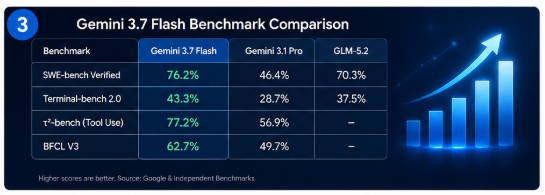
The company reports substantial improvements in real-world software engineering benchmarks. The model is designed to improve issue resolution and reduce failed loops in agentic coding workflows.
This is important because coding agents need more than the ability to generate syntactically correct code. They must understand requirements, work with existing code, identify errors, modify files, and continue working after encountering problems.
Gemini 3.7 Flash is also designed for web development. Google highlights stronger design adherence when generating applications from design mockups, along with improved ability to audit existing codebases against those designs.
Agentic AI Capabilities
Agentic AI has become one of the biggest areas of competition between modern AI companies. Instead of simply answering a prompt, an AI agent can plan and perform a sequence of actions.
The gemini new model is specifically designed for these workflows. Google says Gemini 3.7 Flash provides more reliable multi-step execution and helps reduce failed agent loops.
For example, an AI coding agent could receive a software issue, examine the relevant project files, determine the cause, implement a fix, run tests, inspect the results, and revise the solution.
The ability to perform these steps reliably can be more valuable than achieving a high score on a single traditional question-answering benchmark.
Multimodal Capabilities
Gemini 3.7 Flash is not restricted to text-only processing. The model supports image input, giving it an advantage in applications that require visual understanding.
This can be useful for analyzing screenshots, understanding designs, inspecting visual information, and building applications that combine text and images.
Independent model comparisons also list image-input support for Gemini 3.7 Flash, while the compared GLM-5.2 configuration does not provide image input.
This makes Gemini 3.7 Flash particularly interesting for developers building multimodal applications rather than purely text-based systems.
Gemini 3.7 Flash Benchmark
The gemini 3.7 flash benchmark results provide a useful picture of where the model performs well. Google reports an Artificial Analysis Intelligence Index score of 56 for Gemini 3.7 Flash in its high-thinking configuration.
However, benchmark results should always be interpreted carefully. Different benchmarks measure different abilities, and a model that wins one evaluation may not necessarily be the best choice for every real-world workload.
Independent comparisons from Artificial Analysis show Gemini 3.7 Flash achieving strong results across intelligence, coding, speed, and other measurements. These comparisons also demonstrate that the model’s performance can change depending on whether low, medium, or high thinking is selected.
For this reason, users should avoid judging the model using only one benchmark number.
Gemini 3.7 Flash Speed
Speed is another major advantage of the gemini new model. Artificial Analysis currently reports approximately 330 output tokens per second for Gemini 3.7 Flash in its high-thinking comparison with Gemini 3.1 Pro Preview.
The same comparison reports approximately 115 output tokens per second for Gemini 3.1 Pro Preview. This gives Gemini 3.7 Flash a substantial throughput advantage in that particular measurement.
Speed becomes especially important for applications that generate large amounts of content or make repeated model calls. Faster generation can improve the user experience and reduce waiting time.
However, speed should not be evaluated alone. The best model depends on the combination of intelligence, latency, price, context requirements, and the specific task.
Gemini 3.7 Flash vs 3.1 Pro
The gemini 3.7 flash vs 3.1 pro comparison is one of the most interesting aspects of this release.
Gemini 3.1 Pro was designed as a higher-end reasoning model, while Gemini 3.7 Flash is positioned as a fast and efficient workhorse. Traditionally, users might expect a Pro model to dominate a Flash model, but current independent comparisons make the situation more complicated.
Artificial Analysis currently gives Gemini 3.7 Flash High an Intelligence Index score of 56, compared with 48 for Gemini 3.1 Pro Preview in its comparison.
The same comparison reports approximately 330 tokens per second for Gemini 3.7 Flash High and around 115 tokens per second for Gemini 3.1 Pro Preview.
Both models have a 1-million-token context window and support reasoning. Both are also proprietary Google models rather than open-weight systems.
However, these results should not be interpreted as proof that Gemini 3.7 Flash is universally better. Model performance depends heavily on the benchmark, reasoning setting, prompt, and workload.
Gemini 3.7 Flash vs 3.1 Pro: Pricing
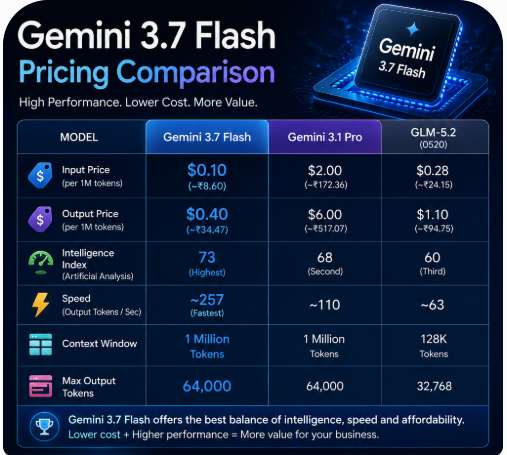
Price is another major difference. Current Google pricing lists Gemini 3.7 Flash at $0.75 per million input tokens and $3.75 per million output tokens during its introductory pricing period.
Third-party comparisons show Gemini 3.1 Pro Preview at substantially higher rates, although exact pricing can depend on token thresholds and processing options. Artificial Analysis’s weighted comparison currently lists approximately $0.58 per million tokens for Gemini 3.7 Flash High versus $1.74 for Gemini 3.1 Pro Preview.
Therefore, developers handling large volumes of requests may find Flash considerably more economical.
Gemini 3.7 Flash vs GLM 5.2
The gemini 3.7 flash vs glm 5.2 comparison is another important battle in the current AI market.
GLM-5.2 is developed by Z.ai and provides a different model philosophy. One of its major distinctions is its open-weight availability, whereas Gemini 3.7 Flash is proprietary.
Artificial Analysis reports that both models have approximately a 1-million-token context window and support reasoning in the compared configurations.
Gemini has an important multimodal advantage in this comparison. The Artificial Analysis profiles list image input support for Gemini 3.7 Flash but not for GLM-5.2 in the compared configuration.
Gemini 3.7 Flash vs GLM 5.2: Intelligence
The result depends on the Gemini thinking level being compared.
Artificial Analysis currently gives Gemini 3.7 Flash Low an Intelligence Index of 51, compared with 53 for GLM-5.2 Max. In that comparison, GLM-5.2 Max has a small intelligence advantage.
At the medium thinking level, however, Artificial Analysis lists Gemini 3.7 Flash at 53 and GLM-5.2 Max at 53, making the comparison essentially even on that particular index.
This shows why simply declaring one model the overall winner can be misleading. Different reasoning settings and workloads can produce different outcomes.
Gemini 3.7 Flash vs GLM 5.2: Speed
Speed is where Gemini 3.7 Flash has a particularly noticeable advantage in the Artificial Analysis comparison.
Gemini 3.7 Flash Low is reported at approximately 315 output tokens per second, compared with approximately 71 tokens per second for GLM-5.2 Max.
At the medium setting, Gemini 3.7 Flash reaches approximately 332 tokens per second, while GLM-5.2 Max is listed around 72 tokens per second.
This difference can matter considerably in applications that generate long responses or make frequent AI calls.
Gemini 3.7 Flash Pricing
The gemini 3.7 flash pricing structure is one of its biggest selling points.
Google currently lists introductory API pricing at $0.75 per million input tokens and $3.75 per million output tokens. The company says this introductory pricing is available through December 31, 2026.
After the introductory period, Google says the pricing will increase to $1.50 per million input tokens and $7.50 per million output tokens.
This change is important for companies planning long-term AI applications. Developers should calculate expected token usage rather than looking only at the headline model price.
For high-volume applications, the difference between input and output costs can become significant. Applications generating lengthy responses may spend considerably more on output tokens than on input processing.
Why Gemini 3.7 Flash Pricing Matters
The value of an AI model cannot be determined by benchmark scores alone. A highly capable model can become difficult to deploy if every request is expensive.
Gemini 3.7 Flash attempts to address this problem by offering strong reasoning and coding capabilities at Flash-level economics.
For developers building applications that make thousands or millions of model requests, cost efficiency can be just as important as intelligence. Lower per-token pricing can make large-scale AI features more financially practical.
This is especially relevant for coding assistants, customer-support systems, research applications, document processing, AI agents, and automated workflows.
Gemini 3.7 Flash Context Window
The 1-million-token context window is another major strength of the gemini new model.
A large context allows developers to provide extensive documentation, source code, reports, or other information without repeatedly dividing it into small pieces.
This can be useful for large software repositories, long technical documents, research material, and complex business workflows.
However, having a large context window does not automatically mean every application should fill it completely. Larger prompts can increase processing requirements, and developers should still provide relevant information whenever possible.
Gemini 3.7 Flash for Businesses
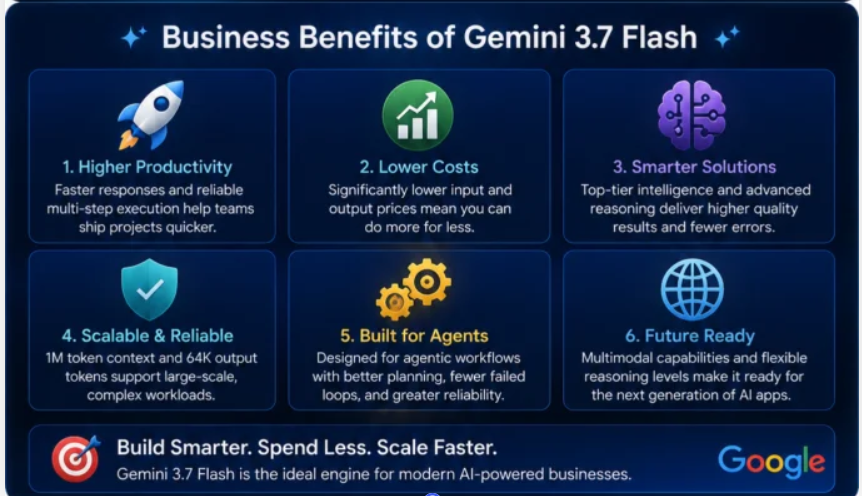
Businesses can use Gemini 3.7 Flash for a wide range of AI-powered applications. Coding assistants are an obvious example, but the model’s capabilities extend beyond software development.
Companies can potentially use it for document analysis, knowledge management, research assistance, workflow automation, content generation, and multimodal applications.
The combination of long context, adjustable reasoning, tool support, and competitive pricing makes it suitable for production systems that need repeated AI interactions.
The biggest advantage for businesses may be its balance. Instead of paying premium-model prices for every request, organizations can use a capable Flash model for a large percentage of their workloads.
Gemini 3.7 Flash for Developers
Developers who build AI-powered applications need more than a chatbot. They need predictable APIs, large context windows, tool support, reasonable pricing, and sufficient intelligence.
Gemini 3.7 Flash addresses several of these requirements simultaneously.
Google’s API documentation states that the model supports the same suite of built-in tools as Gemini 3.6 Flash, while adding stronger coding, agentic, and multi-step execution capabilities.
Its adjustable thinking levels also give developers more control over how much reasoning to use for individual requests.
Gemini 3.7 Flash Limitations
Despite its impressive capabilities, Gemini 3.7 Flash is not automatically the best model for every situation.
Benchmark results vary depending on the evaluation. GLM-5.2 can outperform Gemini 3.7 Flash at certain reasoning settings, while some specialized tasks may favor other models.
Another consideration is openness. Gemini 3.7 Flash is proprietary, so developers cannot treat it like an open-weight model that can be independently downloaded and modified.
The model also has a maximum output size of 64,000 tokens. While this is substantial, some competing models may offer different output limits depending on their configurations.
Who Should Choose Gemini 3.7 Flash?
Gemini 3.7 Flash is particularly attractive for developers who prioritize speed, coding performance, agentic workflows, multimodal input, and cost efficiency.
It is also a strong option for businesses processing large amounts of information because of its 1-million-token context window.
Developers who need open model weights may prefer alternatives such as GLM-5.2. Similarly, specialized reasoning workloads should be evaluated using the benchmarks most relevant to the intended application.
The right choice therefore depends on the workload rather than the model’s marketing label.
Gemini 3.7 Flash vs 3.1 Pro vs GLM 5.2
Looking at all three models together gives a clearer picture.
Gemini 3.7 Flash is focused on being a fast, capable, cost-efficient workhorse. Gemini 3.1 Pro represents a more premium Google model, while GLM-5.2 provides an open-weight alternative with competitive intelligence.
For speed, current Artificial Analysis comparisons favor Gemini 3.7 Flash strongly against both Gemini 3.1 Pro Preview and GLM-5.2 Max.
For openness, GLM-5.2 has the advantage because its weights are available, while Gemini models remain proprietary.
For multimodal input, Gemini 3.7 Flash has an advantage over the compared GLM-5.2 configuration because image input is supported.
For price, Gemini 3.7 Flash is also highly competitive, particularly during its introductory pricing period.
Final Verdict
The gemini new model, Gemini 3.7 Flash, is one of Google’s most interesting AI releases because it focuses on practical performance rather than simply chasing a larger model name.
Its combination of reasoning, coding, agentic execution, multimodal input, 1-million-token context, adjustable thinking, and competitive pricing makes it a compelling choice for modern AI applications.
The gemini 3.7 flash benchmark results show strong performance across coding, software engineering, agentic workflows, and other demanding tasks. Independent evaluations also show impressive speed compared with several competing models.
The gemini 3.7 flash vs 3.1 pro comparison is especially notable because Flash can deliver stronger results on some independent intelligence measurements while also being considerably faster and cheaper in the cited comparisons.
The gemini 3.7 flash vs glm 5.2 comparison is more balanced. GLM-5.2 can lead at certain reasoning settings and offers open weights, while Gemini provides strong speed, image input, and competitive economics.
Finally, gemini 3.7 flash pricing makes the model particularly appealing for high-volume applications. Google’s introductory rate of $0.75 per million input tokens and $3.75 per million output tokens is available through December 31, 2026, with higher rates scheduled afterward.
Overall, Gemini 3.7 Flash is best understood as a high-performance AI workhorse. It may not win every benchmark or suit every developer, but its combination of intelligence, speed, context, multimodality, agentic capabilities, and price makes it a serious contender in the 2026 AI model landscape.
bestttttttttttttttt haaiiiiiiiiiiiiiiiii jiiiiiiiiiiiii